One-Piece Flow Trim Line Replaces Crane-Moved Batches
Swapping a five-job batch table for single-piece flow cut turnaround from 4 hours to about 30 minutes.

- Creator
 TheAMEConnect
- Improvement date
- June 16, 2024
- Company
 Southwest Steel Buildings
- Wastes
Jobs were stacked three to five at a time on a table set on saw horses, then lifted and moved with a crane. The batch had to be spun to be positioned, work queued up, needed jobs got buried under others, and hoisting loaded tables added safety risk.
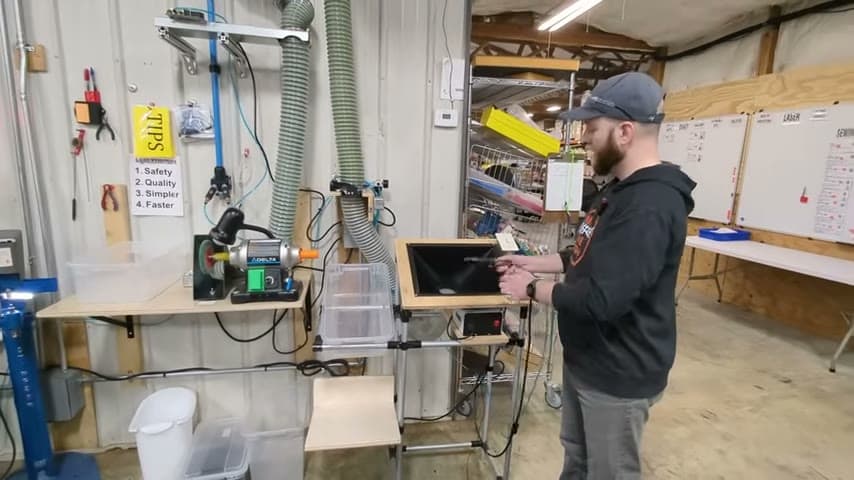
The team built a trim line that moves one job at a time instead of batching multiple jobs on a crane-moved table. Removing the batch eliminated the crane hoist, the queue of waiting work, and the risk of the needed job being buried in the stack.
One-piece flow surfaces the right job at the right time and removes the waste hidden inside batches.
What is a One-Piece Flow Trim Line Replaces Crane-Moved Batches?
One-piece flow means a single unit moves through the process at a time rather than accumulating into batches. Here it replaced a table where three to five jobs were stacked, craned overhead, and spun into position.
Batching feels efficient because you move many jobs in one crane lift, but it hides real cost. Work waits in the stack, the specific job you need is often buried, and moving a loaded table with a crane is a safety hazard.
By switching to one job at a time, the trim line makes each job immediately visible and accessible. The scrap log turnaround dropped from a 4-hour cycle to roughly 30 minutes, with a goal of 15 minutes.
Why it works
Flowing one job at a time makes the current job visible and reusable instead of locked inside a batch that only one person understands.
- Every job is exposed and identifiable, so nobody hunts through a stack for the one they need.
- Removing the crane hoist of loaded tables removes a repeatable safety hazard for everyone.
- A steady single-piece line makes the next standard step obvious and easy to follow.
- Faster turnaround gives quicker feedback on defects instead of burying them in a batch.
Evidence: Scrap log turnaround fell from a 4-hour cycle to about 30 minutes, with a stated goal of 15 minutes.
How to create this idea
- 1Find the batch step
Look for places where jobs are stacked and moved together, like a table on saw horses lifted by crane.
- 2Count what is queued
Note how many jobs pile up per batch, here three to five, and how often the needed one gets buried.
- 3Design a single-piece path
Build a line or fixture that carries one job at a time through the process.
- 4Remove the risky handling
Eliminate the crane hoist and table spin once batching is gone.
- 5Measure turnaround
Track cycle time before and after, then set a stretch target and keep improving.
Best used when
- batched jobs on tables
- crane-moved loads
- jobs get buried
- long turnaround
Less useful when
- true continuous product
- single-job processes
- batch required by process
Products and tools mentioned
- overhead crane: Ceiling-mounted crane used to lift and move heavy loads across a bay.
Tags
- Problem
- batchingburied jobssafety risklong turnaround
- Lean methods
- one-piece flowwaste reductionflow
- Application
- trim linescrap logmaterial handling
Captured from TheAMEConnect at Southwest Steel Buildings in the video "AME 2 Second Lean Tour: Southwest Steel Buildings", at 00:31:17. On Lean Toolbox. Watch the original video on YouTube ↗