Just-in-Time Material Delivery with Laminated Cards for Remnant Tracking
Order materials to arrive only when a project needs them and track leftover remnants on simple laminated whiteboards.
- Creator
 American Precision Engineering
- Company
- American Precision Engineering
- Wastes
Keeping material in stock ties up cash, fills racks, and forces teams to guess what they have. Leftover remnants get lost, so usable stock is either forgotten or reordered.
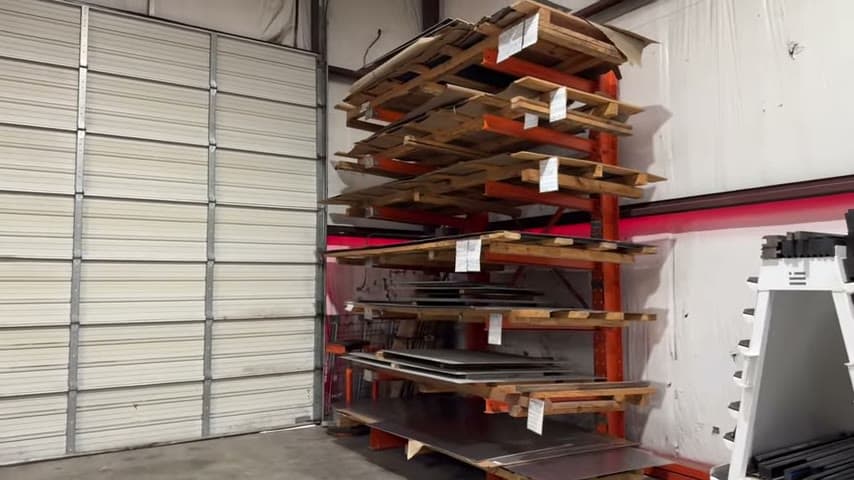
The shop keeps almost no standing material inventory. Everything arrives just in time for the specific project it will be used on. Remnants left over from jobs are tracked on laminated cards used as reusable whiteboards, so what is on the rack is always visible and current.
Pull material to demand and make remaining stock visible so it gets reused.
What is a Just-in-Time Material Delivery with Laminated Cards for Remnant Tracking?
Just-in-time (JIT) inventory means materials are delivered to arrive right when a project needs them rather than being held on shelves in advance. Instead of a stocked warehouse, the rack holds close to zero standing inventory.
The only material that stays on hand is remnants, the usable offcuts left from completed jobs. To keep them from being lost, the team tracks them on laminated card used as simple, wipe-clean whiteboards.
Together these two practices give a low-cost visual inventory: incoming material is pulled to demand, and leftover material is logged where anyone can read it and reuse it.
Why it works
The value is in making the real stock position visible and reusable instead of hidden in piles.
- Laminated remnant boards turn scattered offcuts into a known, reusable resource anyone can check.
- A shared visual list mistake-proofs reordering material the shop already owns.
- JIT delivery removes the guesswork about what is in stock, since the answer is almost nothing plus the logged remnants.
- Reusable laminated cards let the record be updated instantly as remnants change, keeping the knowledge current.
Evidence: Visitors always ask what is kept in stock, and the team can answer clearly: nothing standing, everything just in time, with remnants tracked on the boards.
How to create this idea
- 1Stop stocking standing inventory
Order raw material to arrive just in time for the specific project it is used on rather than holding it on shelves.
- 2Identify remnants worth keeping
After each job, set aside usable offcuts on a defined material rack instead of scrapping or piling them.
- 3Build laminated tracking boards
Take laminated card and use it as a reusable dry-erase whiteboard to list what remnants are on the rack.
- 4Update the board as stock moves
Wipe and rewrite the card whenever remnants are added or consumed so the list always matches the rack.
- 5Extend visual cues with color coding
Color-code racks and tooling bit by bit so materials and tools are easy to find and match to jobs.
Best used when
- project-based fabrication
- reliable supplier delivery
- expensive material
- frequent usable offcuts
Less useful when
- long supplier lead times
- high-volume repetitive runs
- unpredictable demand spikes
Products and tools mentioned
- storage rack: Rack for holding stock, parts, or materials in an organized layout.
- whiteboard: Erasable board used for visual management, scheduling, and team communication.
Tags
- Problem
- excess inventorylost remnantswaiting
- Lean methods
- just-in-timepull systemvisual management
- Application
- material rackfabrication shoptool storage
Captured from American Precision Engineering at American Precision Engineering in the video "Tour of APE's lean shop", at 00:01:44. On Lean Toolbox. Watch the original video on YouTube ↗