Angled Min Max Racks: Control Finished Goods With Visible Shelf Limits
Use angled racks with small minimum and maximum quantities so finished items are easy to restock without overbuilding.
- Creator
 Audacity Micro
- Company
- Henry Holsters
- Wastes
Finished goods in shipping can grow beyond what is needed when each item does not have a clear restock point and a clear shelf limit.
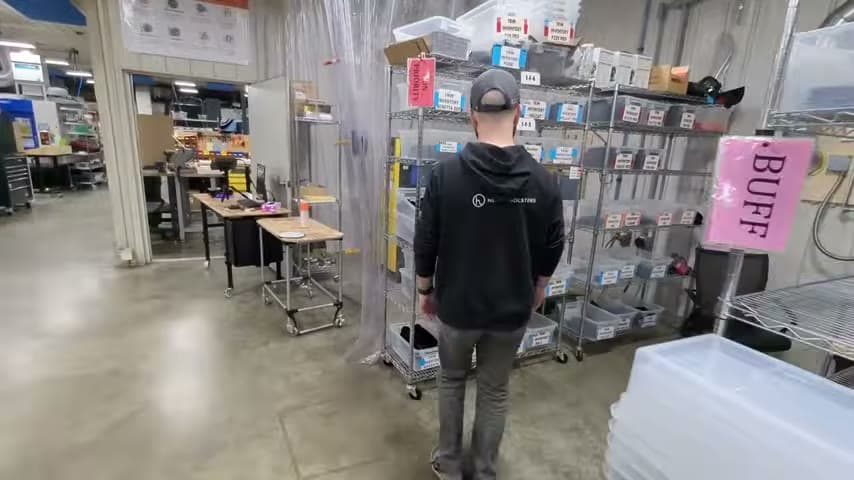
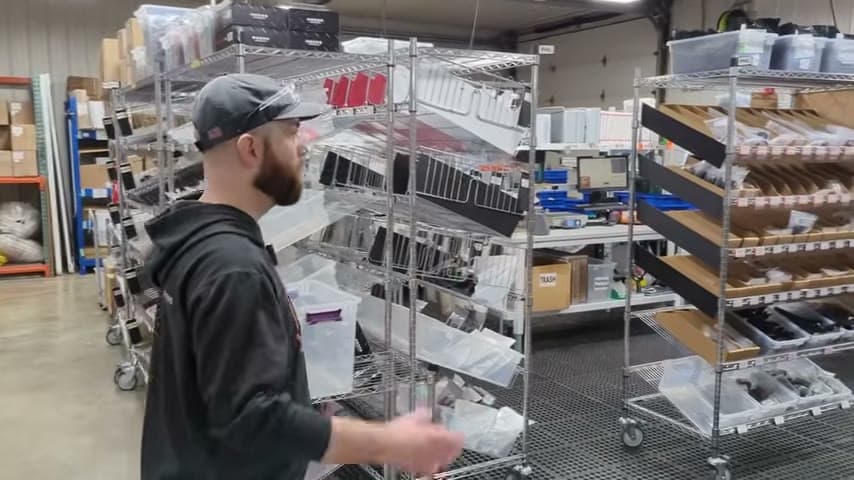
The team stores finished items on angled racks in the shipping area. Each item has a small minimum quantity and an on-shelf maximum, with many maximums not more than 20 pieces and some as few as five pieces.
Make stocking knowledge visible so people reuse the same proven inventory limits.
What is a Angled Min Max Racks?
An angled min max rack is a storage rack that holds a defined quantity range for each finished item. Each location has a minimum quantity that shows when to restock and a maximum quantity that shows when to stop.
In this example, the racks are used in a shipping area for the team's own branded products and products shipped for other companies. The transcript describes finished holsters on the racks that the team can build from scratch and restock.
The rack turns the question of how many to keep into a visible standard. Instead of each person guessing how much finished stock is enough, the shelf limit carries the answer at the point of use.
Why it works
Visible min and max levels convert replenishment knowledge into a reusable standard for shipping and restocking.
- Knowledge reuse: the min and max quantities preserve the team's current best answer for how many finished items to keep on hand.
- Added value: shipping keeps a small useful buffer of finished goods without filling shelves with extra inventory.
- Mistake-proofing: the maximum makes overproduction visible, and the minimum makes the need to restock visible before people have to guess.
- Consistency: anyone restocking the rack can follow the same limit instead of re-solving the quantity decision.
Evidence: The transcript states that the shipping area uses angled racks, keeps minimum quantities, and uses on-shelf maximums of not more than 20 pieces, with some as few as five pieces.
How to create this idea
- 1Choose repeat items
Start with finished items that ship repeatedly and can be replenished reliably. Avoid setting min and max levels for items whose demand or build process is not understood.
- 2Set item limits
Assign a minimum and maximum quantity for each item. Base the limits on demand, shelf space, and how quickly the team can build or restock the item.
- 3Use angled racks
Place the items on angled storage racks in the shipping or fulfillment area. Give each item a clear home so the quantity is easy to check.
- 4Show the standard
Mark the item name, minimum, and maximum at the storage location. The standard should be visible during both picking and restocking.
- 5Restock to max
When an item reaches its minimum, replenish it only up to the maximum. Do not use empty shelf space as permission to make extra.
- 6Review and adjust
Update the limits when demand, product mix, or replenishment time changes. Treat the min and max levels as a working standard, not a permanent guess.
Best used when
- finished goods
- shipping areas
- repeat products
- small buffers
- quick restock
Less useful when
- one-off orders
- unknown demand
- long lead times
- bulky items
Products and tools mentioned
- Angled storage rack: Holds finished items in visible minimum and maximum quantities in the shipping area.
Tags
- Problem
- inventoryoverproductionstockouts
- Lean methods
- visual managementkanbanstandard work
- Application
- shippingfinished goodsrestocking
Captured from Audacity Micro at Henry Holsters in the video "THIS is what a LEAN shop looks like - Lean Machine Shop Tour", at 00:10:24. On Lean Toolbox. Watch the original video on YouTube ↗