Visual Shipping Staging Board to Prevent Trailer Double-Booking
A magnetic staging board makes schedule collisions like double-booked trailers obvious at a glance.
- Creator
 TheAMEConnect
- Improvement date
- June 16, 2024
- Company
 Southwest Steel Buildings
- Wastes
Shipping schedules held in spreadsheets or heads let trailers get double-booked and collisions surface too late, after loads are staged.
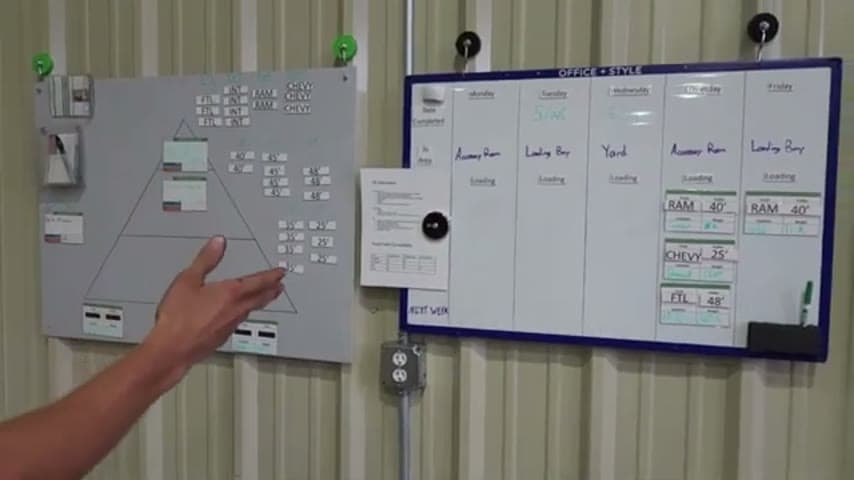
The team built a magnetic work staging board with magnetized truck options and job cards. Each shipment maps to a slot, so a schedule collision such as two loads assigned to one trailer is immediately visible and resolved on the spot.
Make the schedule visible so conflicts reveal themselves before they cause problems.
What is a Visual Shipping Staging Board to Prevent Trailer Double-Booking?
A shipping staging board is a physical visual planner where each trailer or dock slot and each job is represented by a magnetized card. Moving a card to a slot commits a shipment to a time and a trailer, and the board shows the full day's plan in one view.
Because the cards and truck options are magnetized, the board is easy to update as plans change. Anyone walking past can read the current shipping picture without asking or pulling up a screen.
The board turns invisible scheduling logic into a shared, tangible artifact. When two cards land on the same trailer, the collision is obvious and gets fixed before anything is loaded.
Why it works
The board makes a proven scheduling method visible and reusable instead of trapped in one person's memory.
- A shared board lets the whole team reuse the same schedule knowledge, not just the planner.
- Collisions like double-booked trailers become self-evident, mistake-proofing the plan.
- A standard slot-per-trailer layout adds value by giving everyone one reliable source of truth.
- Magnetized cards make updates fast so the board stays current and trusted.
Evidence: The staging board owner reports it as one of the big improvements made in his area.
How to create this idea
- 1Define your slots
List every trailer or dock as a fixed position on the board.
- 2Make truck options magnetic
Create magnetized truck or trailer options so each shipping resource has a physical presence.
- 3Make job cards magnetic
Represent each shipment as a magnetized card that can move between slots.
- 4Assign cards to slots
Place each job card under the trailer it is booked to so the plan is visible.
- 5Watch for collisions
Any slot with two cards flags a double-booking; resolve it immediately by re-slotting.
- 6Update as plans change
Move cards throughout the day so the board always shows the real plan.
Best used when
- shipping scheduling
- limited trailers or docks
- frequent plan changes
- shared team planning
Less useful when
- fully automated dispatch
- single daily shipment
- remote-only teams
Products and tools mentioned
- Kanban cards: Signal cards that trigger material replenishment when inventory reaches a set point.
- magnetic board: Metal board used to display cards, documents, or magnetic labels.
Tags
- Problem
- double-bookingscheduling errorshidden conflicts
- Lean methods
- visual managementmistake-proofingstandard work
- Application
- shippinglogisticsscheduling
Captured from TheAMEConnect at Southwest Steel Buildings in the video "AME 2 Second Lean Tour: Southwest Steel Buildings", at 00:16:59. On Lean Toolbox. Watch the original video on YouTube ↗