Pull-Out Divided Shelf: Keep Standard and Undermount Screws at Point of Use
A divided pull-out shelf keeps both screw types visible, separated, and ready where the work happens.

- Creator
 WillytheMinimalist
- Company
- Hunter Trim & Cabinets Inc.
- Wastes
Workers needed standard mount screws and undermount screws at the workstation, but when they ran low they had to go out front. Keeping the screws away from the work also made the correct setup less visible and easier to vary by person.
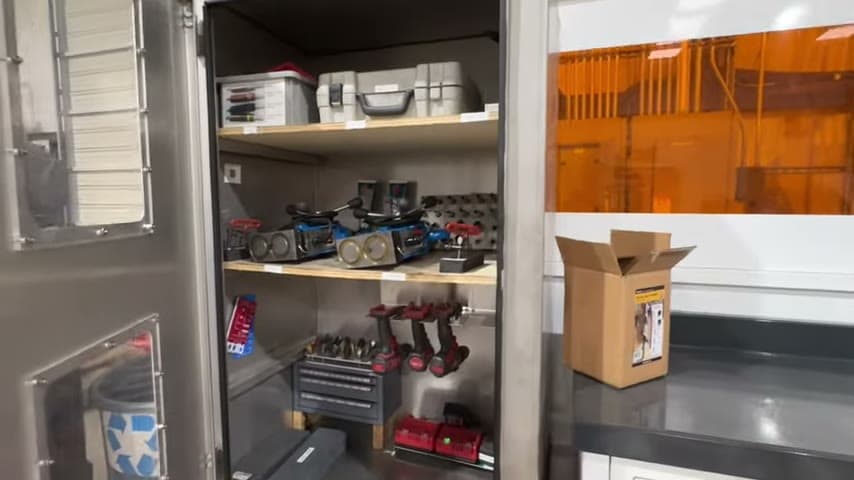
The team added a pull-out divided shelf at the workstation. It holds standard mount screws and undermount screws in separate sections so the needed screws are available and easy to tell apart at the point of use.
Make proven part choices visible and reusable at the point of use.
What is a Pull-Out Divided Shelf?
A pull-out divided shelf is a sliding shelf or drawer with separated spaces for small parts. In this example, the shelf holds standard mount screws and undermount screws side by side at the workstation.
The divider turns the shelf into a simple visual standard. Anyone using the station can see which screw types belong there, where each one goes, and when the supply is getting low.
The main value is knowledge reuse. The best known setup for the station is built into the storage, so people do not have to remember where screws are kept, re-decide the layout, or risk mixing similar fasteners.
Why it works
This works because the shelf captures the correct screw setup and makes it visible, repeatable, and harder to use incorrectly.
- Knowledge reuse: the workstation shows which screw types are required and where each one belongs.
- Added value: the operator can stay focused on assembly instead of solving a storage or restocking problem during the job.
- Mistake-proofing: divided sections reduce the chance of mixing standard mount screws with undermount screws.
- Visual control: a low screw supply is easy to see because both screw sections are exposed when the shelf pulls out.
Evidence: The transcript says the shelf pulls out, holds standard mount screws and undermount screws divided right there, and means workers do not have to go out front when they run low.
How to create this idea
- 1List the needed screws
Identify the screw types that are repeatedly used at the workstation. Keep the list limited to parts that should always be available for that work.
- 2Add pull-out storage
Install or place a pull-out shelf close to the work area. Choose a location that makes the screws visible and easy to access without leaving the station.
- 3Separate each type
Create one assigned space for standard mount screws and one for undermount screws. Do not let similar fasteners share the same compartment.
- 4Make the standard obvious
Mark each section so the correct screw type is clear to any worker. The layout should teach the setup without explanation.
- 5Define low supply
Agree on what running low looks like for each section. Refill before the shelf is empty so the point of use standard stays reliable.
- 6Reuse the pattern
Apply the same divided shelf idea anywhere similar screws or small parts are used together. Improve the layout when the team finds a better standard.
Best used when
- similar fasteners
- repeated assembly
- fixed workstation
- point of use parts
- frequent restocking
Less useful when
- one time work
- rare parts
- bulky materials
- no stable location
Products and tools mentioned
- Pull-out shelf: Used as the sliding point of use storage for the divided screw supply.
- Screws: Standard mount screws and undermount screws are stored separately on the shelf.
Tags
- Problem
- part searchwrong partsrestocking
- Lean methods
- point of usevisual managementmistake-proofing
- Application
- assemblyfastenersworkstation
Captured from WillytheMinimalist at Hunter Trim & Cabinets Inc. in the video "Lean Tour of Hunter Trim & Cabinets Inc.", at 00:05:10. On Lean Toolbox. Watch the original video on YouTube ↗