Clamped Mesh Cooling Rack: Hold Folded Shells in the Proven Shape While They Cool
Clamp each heat-folded shell on its model specific slug, then cool it on a visible mesh rack before the next operation.
- Creator
 Audacity Micro
- Company
- Henry Holsters
- Wastes
Heated folded shells can lose their intended shape if they are handled, stacked, or released before they cool. That creates defects and unclear waiting between forming and the next step.
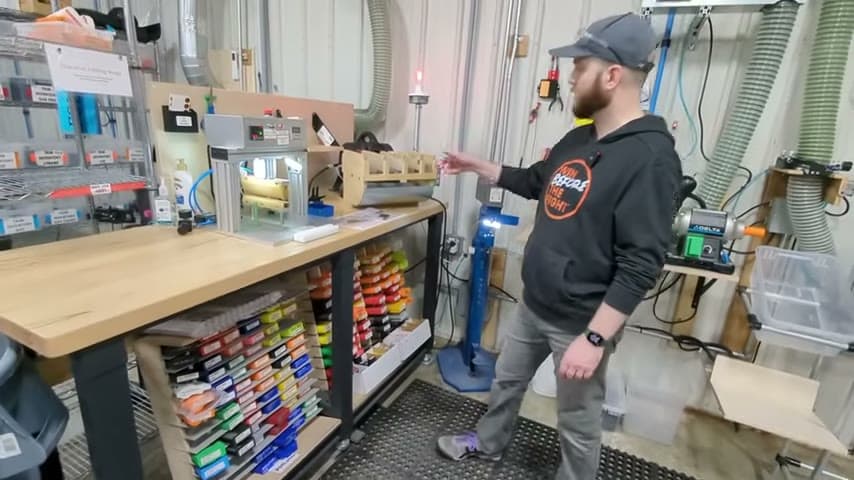
The team uses a top and bottom strip heater with time and temperature settings, folds each shell around a 3D printed slug for that gun model, clamps it, and places it on a plywood, sheet metal, and plastic mesh cooling rack.
Make the proven shape visible, reusable, and held until the part is stable.
What is a Clamped Mesh Cooling Rack?
A clamped mesh cooling rack is a dedicated place for heat-formed shells to cool while held in the correct geometry. In this example, the rack is made from plywood, sheet metal, and plastic mesh.
The important feature is the reusable forming knowledge. The team has 3D printed slugs for every gun model they make, so each shell is folded around the correct proven form instead of being shaped from memory.
After folding, the shell stays clamped to the slug while it sits on the cooling rack. The rack creates a standard handoff between forming and the next operation, such as using a kick press to install metal eyelets or grommets.
Why it works
This works because the process captures the correct form, holds it during waiting time, and makes the cooling state visible.
- Knowledge reuse: each 3D printed slug stores the known good shape for a specific gun model.
- Added value: cooling protects the forming work already done instead of allowing the shell to relax before the next step.
- Mistake-proofing: the clamp and slug keep the shell in the intended geometry while it cools.
- Standard work: strip heater time and temperature settings help operators repeat the same forming condition.
Evidence: The transcript states that shells are heated in a strip heater with time and temperature settings, folded around 3D printed slugs for every gun model, then clamped and placed on a plywood, sheet metal, and plastic mesh cooling rack.
How to create this idea
- 1Find the unstable step
Identify parts that change shape after heating, bending, or forming. Treat cooling time as part of the process, not as loose waiting.
- 2Make variant forms
Create a reusable form for each product variant. Use a 3D printer when the shape is model specific and needs to be copied consistently.
- 3Standardize heat settings
Use a strip heater or other controlled heating method with defined time and temperature settings. Keep the setting visible at the work point.
- 4Clamp on the form
Fold the hot shell around the correct slug and clamp it before it can move. The clamp should hold the part in the final geometry during cooling.
- 5Use a visible rack
Place the clamped shell and slug on a dedicated mesh cooling rack. Build the rack from simple materials, such as plywood, sheet metal, and plastic mesh, if that is sufficient.
- 6Release to the next step
Move the part forward only after it has cooled enough to hold shape. Use the rack as the standard handoff before operations like pressing eyelets or grommets.
Best used when
- heat formed parts
- model specific shapes
- cooling wait time
- shape variation
- manual forming
Less useful when
- no cooling needed
- parts set instantly
- fully automated forming
- no variant shapes
Products and tools mentioned
- 3D printer: Additive manufacturing machine that builds custom parts, jigs, and fixtures from digital models.
- Clamps: Hold the folded shell against the slug while it cools.
- Strip heater: Used as a top and bottom heater with set time and temperature for each shell.
- grommets: Metal eyelets, described as grommets, are installed after cooling.
- kick press: Used after cooling to install metal eyelets or grommets.
- plastic mesh: Used as part of the cooling rack described in the transcript.
- plywood: Layered wood panel used for fixtures, crates, and shop construction.
- sheet metal: Used as part of the cooling rack described in the transcript.
Tags
- Problem
- defectswaitingshape variation
- Lean methods
- knowledge reusemistake proofingstandard work
- Application
- heat formingcoolingfixtures
Captured from Audacity Micro at Henry Holsters in the video "THIS is what a LEAN shop looks like - Lean Machine Shop Tour", at 00:16:13. On Lean Toolbox. Watch the original video on YouTube ↗