Flat Battery Base Drills: Stand Cordless Drivers Upright at the Bench
Choose drill drivers with flat battery bases so the proven tool setup is visible, stable, and easy to repeat.
- Creator
 Audacity Micro
- Company
- Henry Holsters
- Wastes
Bench drills without a stable upright position are harder to return consistently, harder to scan at a glance, and easier to mix into a loose tool pile.
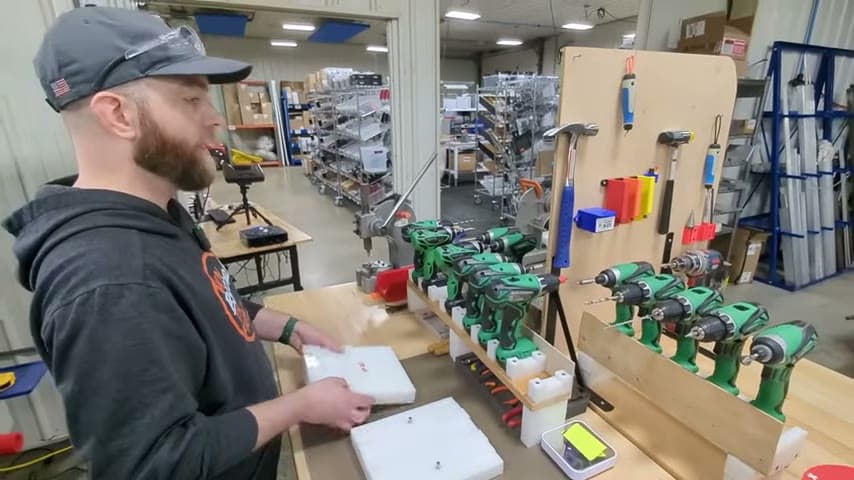
The team uses cordless drill driver sets with flat battery bases so the drills stand upright at the station. They choose compact drill drivers that fit the work instead of overspecifying with a hammer drill or larger voltage platform.
Make the proven tool choice visible and easy to reuse.
What is a Flat Battery Base Drills?
A flat battery base drill is a cordless drill driver whose battery pack forms a stable, flat bottom. The drill can stand upright at the bench instead of lying on its side or leaning on another object.
In this setup, the flat base supports a simple tool standard. The transcript describes using 12 volt drill driver sets because they fit the work, while a hammer drill or 18 volt tool is not needed.
The improvement is the combination of tool selection and storage behavior. The right style of drill shows people what works here, where it belongs, and how to leave it for the next person.
Why it works
An upright drill turns a good tool choice into visible, reusable knowledge at the station.
- Knowledge reuse: the station shows which drill style works for the job, so future users and buyers do not solve the same selection problem again.
- Added value: the team gets the drilling and driving capability needed for the work without buying extra capability that is not needed.
- Mistake-proofing: the upright home position makes the normal condition obvious, so a missing, wrong, or poorly returned drill is easier to notice.
Evidence: The transcript says the team continued buying 12 volt drill driver sets because they fit the work, and that a hammer drill or 18 volt tool was not needed.
How to create this idea
- 1Define the work need
List what the drill must actually do at the bench. Do not default to a larger tool if the work does not require it.
- 2Choose a flat base
Select a cordless drill driver with a battery base that stands upright on the bench without a holder.
- 3Standardize the setup
Use the same proven drill style for similar stations when it performs the work well. Make the preferred choice clear to anyone who replaces or adds tools.
- 4Set the home position
Place each drill upright in a consistent spot at the station. The normal condition should be visible at a glance.
- 5Review before buying more
When adding drills, compare options to the current standard. Change the standard only when the work need changes.
Best used when
- bench drilling
- repeat tool use
- shared stations
- compact drivers
Less useful when
- hammer drilling
- high torque work
- mobile work
- non-flat batteries
Products and tools mentioned
- cordless drill driver: Used at the bench station with a flat battery base so it stands upright.
Tags
- Problem
- tool storagetool selectionmissing tools
- Lean methods
- standard workvisual managementmistake proofing
- Application
- bench workdrillinghand tools
Captured from Audacity Micro at Henry Holsters in the video "THIS is what a LEAN shop looks like - Lean Machine Shop Tour", at 00:07:22. On Lean Toolbox. Watch the original video on YouTube ↗