Deburring Station Placed Next to the Laser for Immediate Part Processing
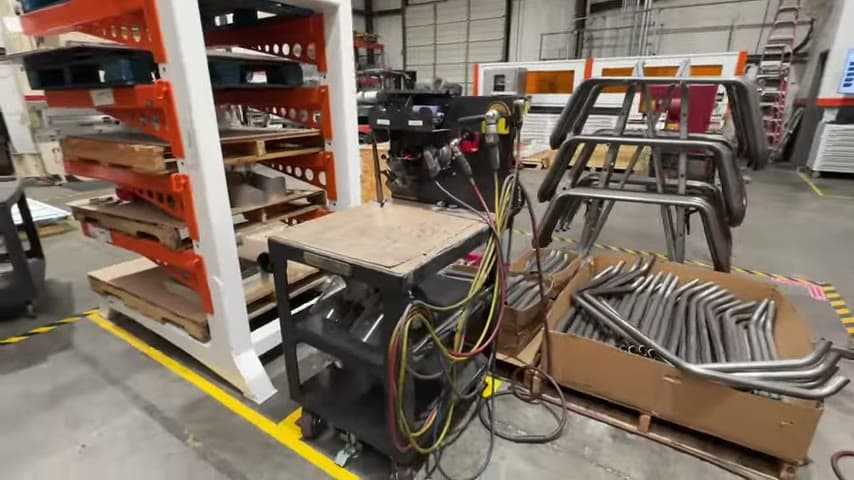
A deburring cart positioned beside the laser lets parts go straight from cutting to finishing without an intermediate hand-off.
- Creator
 American Precision Engineering
- Company
- American Precision Engineering
- Wastes
Parts coming off the laser cutter need deburring, but when the deburring station sits away from the laser, parts get set down, staged, or moved before finishing, adding handling and creating a buffer of unfinished work.
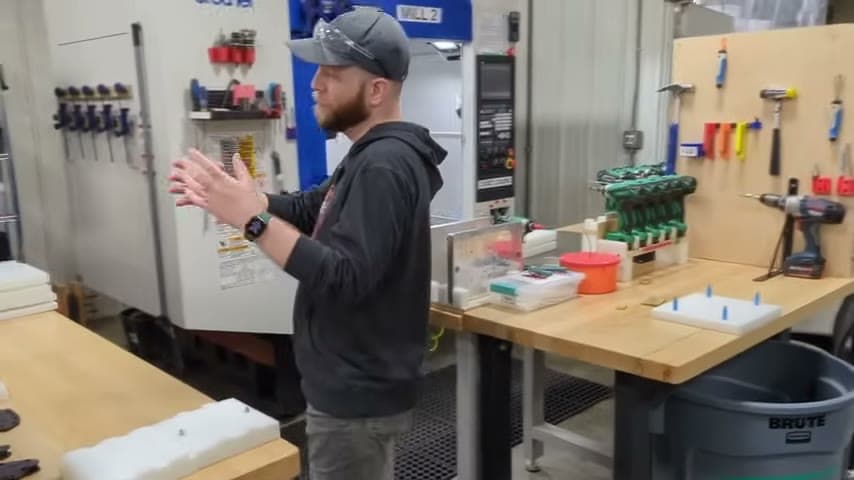
The team built and placed a deburring system center on a cart directly next to the laser, so operators can take parts right off the laser and deburr them immediately without setting them anywhere in between.
Locate the next processing step at the point of use so work flows without staging or extra handling.
What is a Deburring Station Placed Next to the Laser for Immediate Part Processing?
This is a point-of-use deburring station: a mobile cart holding the deburring tools positioned immediately next to the laser cutter. Parts move directly from the laser to deburring in one continuous flow.
Deburring removes the sharp edges and burrs left on metal after laser or plasma cutting. By placing the deburring cart adjacent to the laser, the operator finishes each part right where it comes off the machine rather than carrying it to a separate area.
The cart was built in-house over a year ago, making the setup a durable, purpose-designed fixture rather than a temporary arrangement. Because it is a cart, it can be repositioned if the layout changes.
Why it works
Co-locating deburring with the laser turns a proven finishing sequence into a visible, repeatable standard that anyone can follow.
- Makes the correct next step obvious: parts go straight to the adjacent cart, not to a random staging spot.
- Mistake-proofs handling by removing the temptation to set unfinished parts down and lose track of them.
- Builds finishing into the flow so quality (edge deburring) is done once, at the source, before defects travel.
- The in-house cart captures the team's layout knowledge in a reusable fixture other cells can copy.
How to create this idea
- 1Identify the immediate next step
For laser-cut parts, deburring is typically the next required operation. Confirm what must happen before a part can move on.
- 2Build a mobile deburring cart
Assemble the deburring tools onto a cart so the station is self-contained and can be positioned exactly where needed.
- 3Place it directly beside the laser
Position the cart within arm's reach of the laser output so parts transfer directly, with no intermediate table or bin.
- 4Set the rule: no setting parts down
Standardize that operators take parts right off the laser and deburr in place if needed, avoiding staging piles.
- 5Keep it flexible
Because it is a cart, reposition it when layouts or product mixes change so it stays at the point of use.
Best used when
- laser cutting cells
- deburring required
- single-piece flow
- reducing part handling
Less useful when
- batch offline finishing
- deburring automated inline
- no burrs produced
Products and tools mentioned
- laser cutter: Laser machine used to cut sheet material with precision for fabrication.
Tags
- Problem
- extra handlingstagingpart flow
- Lean methods
- point of useflowmistake-proofing
- Application
- laser cuttingdeburringmetal fabrication
Captured from American Precision Engineering at American Precision Engineering in the video "Tour of APE's lean shop", at 00:04:34. On Lean Toolbox. Watch the original video on YouTube ↗