Labeled Forklift Buckets for Ratchets, Straps, and Corners
Point-of-use buckets on the forklift keep loading supplies stocked, sorted, and ready before every job.
- Creator
 TheAMEConnect
- Improvement date
- June 16, 2024
- Company
 Southwest Steel Buildings
- Wastes
Loading a load means grabbing ratchets, straps, and corner protectors. When those items live inside the building, the operator has to break away from the yard and walk back for supplies, killing work momentum and adding trips.
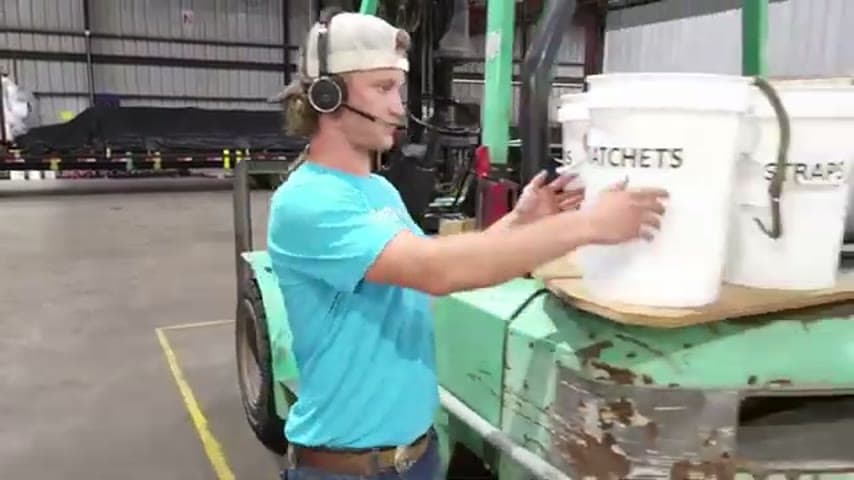
The team mounted labeled buckets on the forklift, one each for ratchets, straps, and corners. The supplies travel with the machine, so the operator has what they need at the point of use without returning to the building.
Store tools at the point of use, labeled and standardized, so the right item is always ready where the work happens.
What is a Labeled Forklift Buckets for Ratchets, Straps, and Corners?
This is a point-of-use storage setup: labeled buckets fixed to the forklift that hold the consumables needed for loading, namely ratchets, straps, and corner protectors.
Each bucket has a defined item and a label, so anyone using the forklift knows where each supply belongs and can see at a glance whether it is stocked. The storage moves with the equipment instead of sitting inside the building.
It is a simple visual and mobile kanban idea: the container standardizes what goes where, and its presence on the machine means the supply is always present when the operator is out in the yard.
Why it works
The value is that a proven loading kit is made visible and reusable on the machine itself, so no one has to remember or rediscover what a load requires.
- Labels standardize what belongs in each bucket, so any operator can restock and use it the same way.
- A missing or empty bucket is instantly visible, mistake-proofing against starting a load without the right straps or corners.
- The kit captures the team's known answer to what a load needs, keeping that knowledge on the forklift instead of in one person's head.
- Keeping supplies at the point of use preserves work momentum by removing return trips.
Evidence: The operator notes that trips back into the building kill momentum, so keeping supplies on the forklift preserves it.
How to create this idea
- 1List what a load actually requires
Take the time to figure out every consumable a loading job needs, such as ratchets, straps, and corners.
- 2Assign one bucket per item
Give each supply type its own container so items stay sorted and easy to grab.
- 3Label each bucket clearly
Mark every bucket with its contents so any operator knows what goes where and can spot when it is empty.
- 4Mount the buckets on the forklift
Fix the buckets to the machine so the supplies travel to the point of use out in the yard.
- 5Restock at a set point
Refill the buckets on a routine so the loading kit is always ready before the next job.
Best used when
- mobile equipment
- point-of-use supplies
- frequent yard trips
- loading operations
Less useful when
- fixed workstations
- rarely used tools
- no shared equipment
Products and tools mentioned
- buckets: Containers for holding parts, liquids, waste, or cleaning supplies.
Tags
- Problem
- wasted tripsmissing supplieslost momentum
- Lean methods
- point of usevisual managementstandardization5S
- Application
- forklift loadingyard operationsshipping
Captured from TheAMEConnect at Southwest Steel Buildings in the video "AME 2 Second Lean Tour: Southwest Steel Buildings", at 00:22:51. On Lean Toolbox. Watch the original video on YouTube ↗